

Superintelligence will not repaint a bridge.
Every miracle stands on steel. Intelligence has become cheap; doing has not. The next lever for human productivity is physical, and it is not a robot shaped like us.
Every miracle stands on steel.
The model that answers your question is a building, a substation, a cooling plant, a chip fab and a shipping lane before it is a single line of text. A city is water mains, bridges, tank farms and a grid before it is a city. Every miracle of the last century, and every miracle of the next, stands on twenty trillion dollars of steel, and today not one autonomous robot lives on it.
Intelligence has become cheap. Doing has not. The crews, scaffolds, drydocks and containment tents that maintained the Brooklyn Bridge in 1914 maintain it today. After superintelligence, the lever that raises the productivity of a society is physical: getting better at the tasks that everything else rests on. That is physical AI, and infrastructure is where it matters most.
of steel holds up modern life
spent every year to keep it standing
autonomous robots live on it today
the painters above; the job has not changed
Your body is not maintained by tiny people
Your body does not shut down every thirty years so that a crew can scaffold it and look for cracks. It is kept alive by cells shaped for the job, living in the tissue, sensing and repairing every day. Your skeleton is rebuilt a little at a time, by cells that never leave the bone, which is why it never has to be rebuilt all at once.
Steel is the skeleton of civilisation, and today it is dead bone. A bridge gets no continuous care, so it gets one $721 million rehabilitation after fifty-five years. A tanker drags barnacles for two years between cleanings. A tank is emptied for seven months so that someone can look at its floor. Gobo builds the cells: small, permanent robots that live on the steel, measure it on every step, and repair the first blister, the first crack and the first slime before any of them becomes a job.
That is also why the robot is not shaped like a person. Evolution did not maintain the body with tiny humans; it made cells for the tissue. Infrastructure is vertical, submerged, hot, dark and electrified, a world in which the human form is the fragile part. Humanoids are built for human spaces. Gobo’s robot is built for steel.
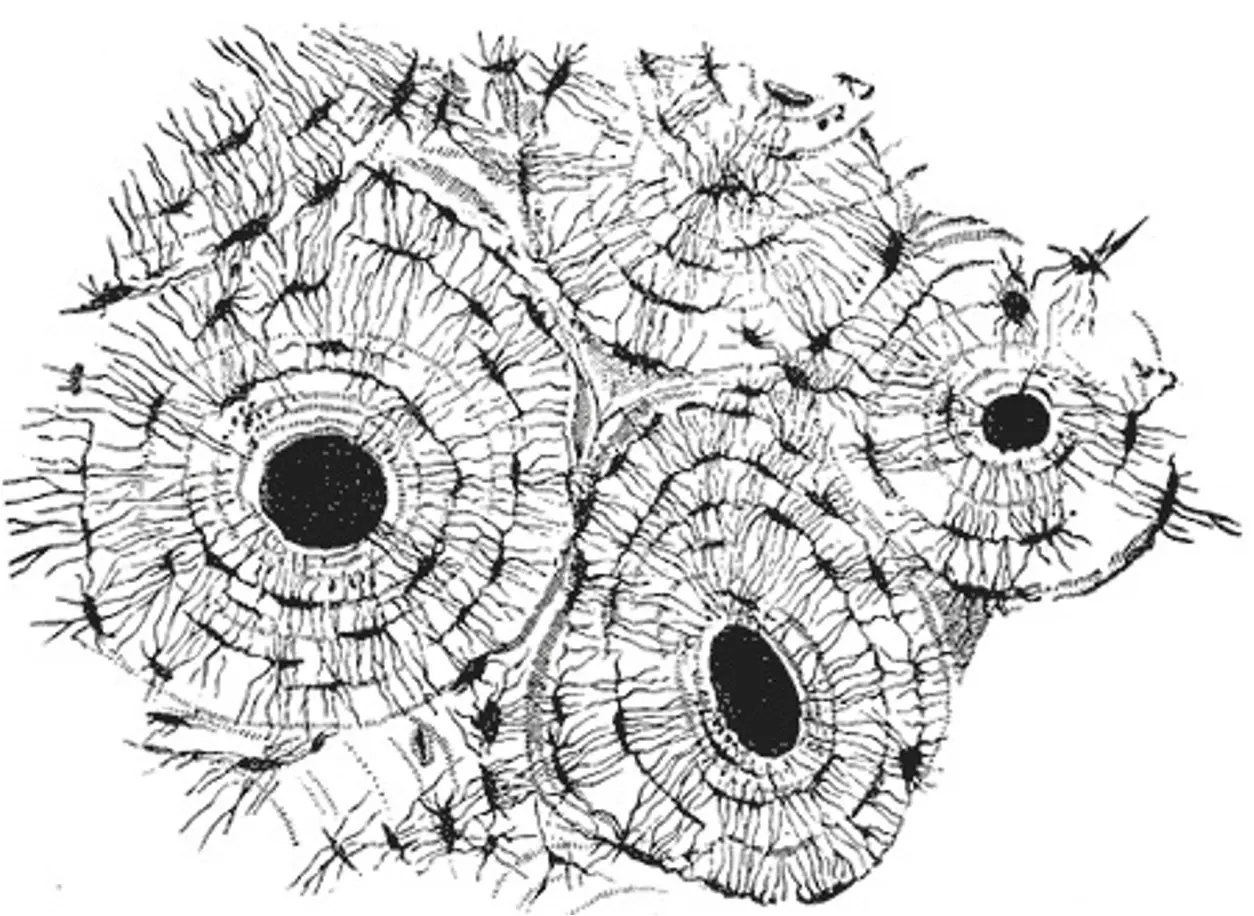
compact bone in cross-section, Gray’s Anatomy (1918), public domain. The canals carry the cells that rebuild the bone around them.
Your skeleton
- Rebuilds a little every day
- Cells live in the bone
- A crack is repaired before you feel it
- Rebuilt all at once: never
A bridge today
- Inspected every two years; 2% of the steel
- Crews visit, then leave
- A crack is found when it is a problem
- Rebuilt all at once; every fifty-five years, $721M
A bridge with Gobo
- Measured on every traverse
- Robots live on the steel
- A blister is touched up that afternoon
- Rebuilt all at once; never again
They thought the world needed five computers
In the first decades of computing, the people who knew most about computers guessed worst at how many the world would want, because they counted the machines of their day doing the jobs of their day. Our industry makes the same mistake when it counts inspection crawlers. Nobody asks how many cells a body needs. The honest answer to how many robots will live on infrastructure is one for every place a crack can start. We say 200,000 for the six markets we know; the number will be wrong in the same direction the five computers were.
Why not a humanoid? The dynamo.
When factories first got electricity they replaced the one big steam engine with one big electric motor and kept the belts, and for forty years productivity barely moved. The gain came when motors became small, cheap and built into every machine. The humanoid is the one big motor: a robot shaped like the worker it replaces. The productivity of physical AI arrives when robots become small, numerous and part of the structure. (Paul David, ‘The Dynamo and the Computer’, 1990.)
Six markets. One robot.
The same machine, with different payloads, on the steel that owners spend $500 billion a year to keep in service.
Bridges & Highway Structures
Inspection, Sandblasting and Painting across 600,000+ bridges . Deploying robots wherever it is hazardous for human workers. Data matters: a fatigue crack found at ten millimeters is a drilled hole and an afternoon’s work; the same crack two years later is a closed bridge.
Maritime Hulls
Resident subsea robots that groom ship hulls at every stop, keeping drag in the hydraulically smooth regime (ks < 30 µm) to cut fuel bills by 10–50%.
Energy & Storage Tank Farms
Climbing walkers inspecting internal/external shell integrity without draining assets.
Offshore Wind & Platforms
Permanent crawlers enduring extreme marine splash zones to detect fatigue and coat critical steel welds.
Power Plants & Dams
Permanent acoustic and visual monitoring systems deployed on non-stop inspection duties across severe environments.
Industrial Facilities & Pipelines
Autonomous wall-climbing robots gathering continuous wall-thickness data across miles of piping networks.
Put the first permanent robot on your asset
Supervised paid pilots begin in 2028 on hulls, with tanks, offshore foundations and bridges following on the same platform. Tell us about your steel and we will tell you what a resident robot would do on it.