

Fix it once, then keep it that way
Gobo's blasting and painting robots make this generation's bridge rehabilitation faster, cleaner and safer. The same robots then stay on the bridge, so that the next generation never needs to do this again.
TODAY: A GENERATION OF CARE IN ONE CONTRACT
$721M
The Gold Star Memorial Bridge contract, October 2025
On 3 October 2025 Connecticut awarded a $721,348,812 contract to rehabilitate the northbound Gold Star Memorial Bridge on I-95. The deck is fifty-five years old. The entire superstructure will be repainted, the steel strengthened, the bearings and joints renewed. Four years of lane closures are the interest on the loan.
Scotland’s Forth Bridge took ten years, $170 million, 4,000 tonnes of scaffolding and 1,500 people to repaint. The promise at the end: no full repaint for at least twenty years. The job that never ended became the job that returns every twenty-five.
Inside the containment tent, airborne lead runs 2,000 to 50,000 micrograms per cubic metre against a legal limit of 50 (10 in California). Roughly half of what the owner pays is the cost of getting people safely to the steel.
How we help today: robots inside the tent
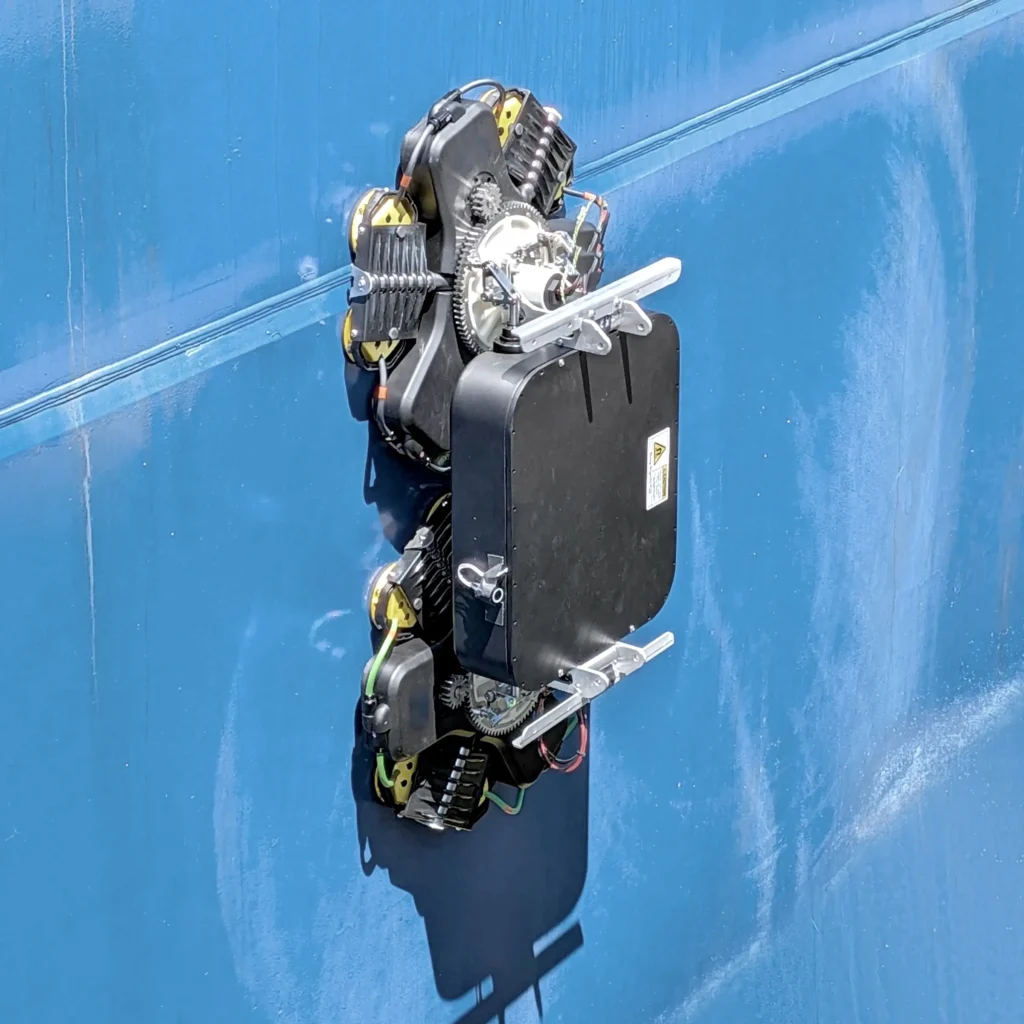
Rail-mounted blasting robots already strip the Sydney Harbour Bridge; Virginia is testing laser ablation of lead paint. Gobo’s first bridge product is built for exactly this work: a blasting and painting robot that keeps people out of the lead, cuts containment cost and shortens lane closures on the rehabilitation that is happening now.
And from then on: custody, not campaigns
Picture a 1950s steel truss bridge like Boston’s Tobin in 2031, freshly rehabilitated, with three resident robots docked under the deck. Each spring they walk the girder ends and bearings where the road salt collects and wash it off, the cheapest preventive act on a steel bridge and the one nobody performs because access costs the same as inspection.
Every traverse is also an inspection: thickness at the thin spots, a crack-length reading at every fatigue-prone weld, a coating map with the first blisters flagged. Where the paint breaks down the robot touches it up that afternoon, not in 2056.
The engineers see a condition time series instead of a two-year-old photograph. Instead of one massive repair job after fifty years, robots keep the bridge in mint condition by doing small repair jobs every week.
large steel bridges worldwide
replacement value
spent on maintenance every year
spent on inspection every year